
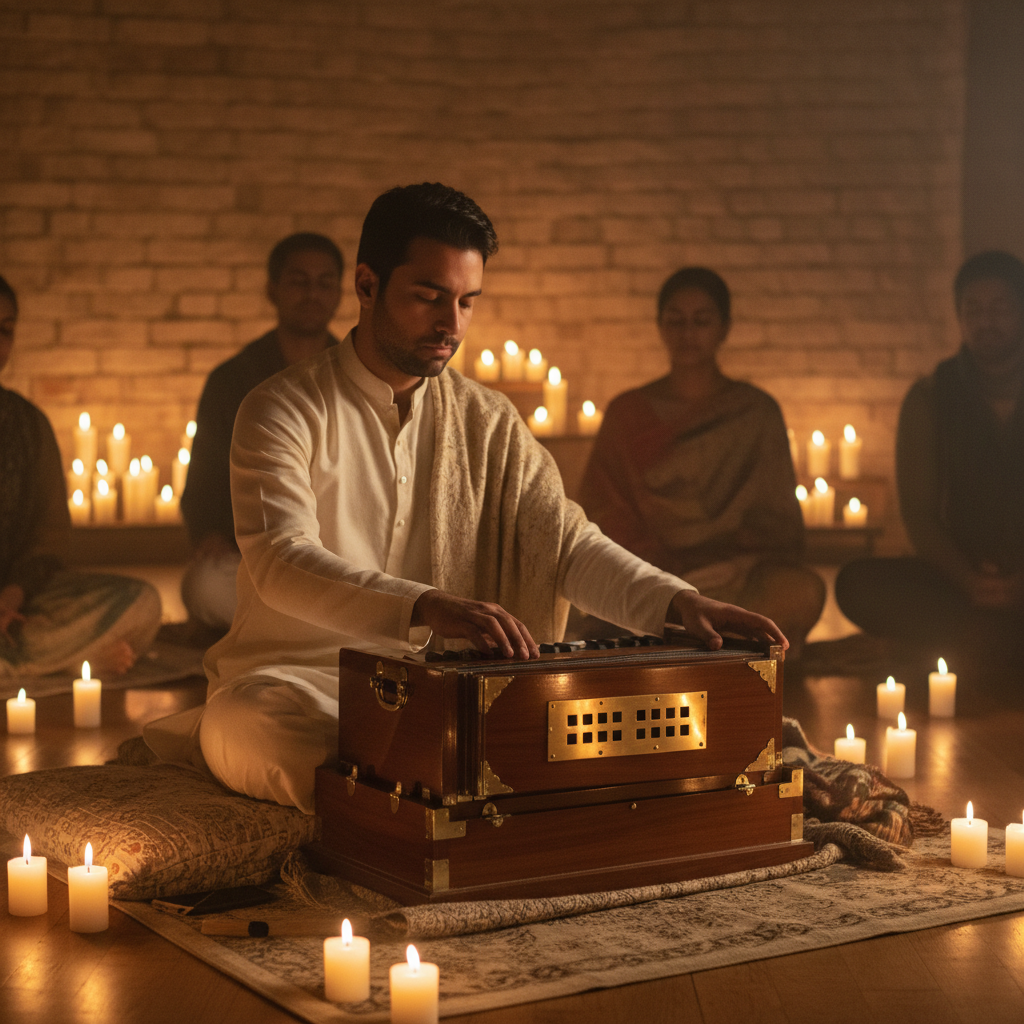
Krishna Das — born Jeffrey Kagel in Long Island, New York — spent years studying with Neem Karoli Baba in India in the early 1970s. When his teacher died in 1973, he returned to the United States carrying a grief that took decades to metabolize. He began teaching kirtan not as a career but as a practice, and found that the practice worked on other people the way it had worked on him.
He is not a performer in the conventional sense. He sits on a stage with a harmonium, repeats names, and waits for something to happen in the room. Sometimes it takes twenty minutes. Sometimes it takes the whole night. The repetition is the point.
Why It Matters
Krishna Das comes out of the Neem Karoli Baba lineage — one of the most significant and well-documented transmission lineages connecting India to the Western spiritual world in the twentieth century. His teachers include Ram Dass, and his practice has been shaped by decades of direct contact with Indian devotional tradition at its source.
In practice, what happens at a Krishna Das concert is not a performance. It is a call-and-response chanting session. Attendees repeat back the names he sings. The format is ancient — kirtan has been practiced in the Bhakti tradition for over a thousand years — but Krishna Das has found a way to make it accessible to Western practitioners without diluting what makes it work.
The documented significance here is substantial. Ram Dass wrote about him at length. The New York Times has covered his work multiple times. He has sold out Carnegie Hall. More importantly, thousands of practitioners across decades have described the specific effect of his chanting on their own practice — not as entertainment, but as a transmission that changed how they understood devotion. The evidence base for including him is unusually strong.
Tip
Find Krishna Das in a smaller venue rather than a large festival. The smaller the room, the more it lands. A two-hundred-person kirtan in a yoga studio is a different experience than a thousand-person event in an auditorium — the call-and-response becomes something closer to a conversation, and the practice has room to do what it does.
Bridge Recommendation
Can't travel to a Krishna Das event? His recordings — particularly "Pilgrim Heart" and "Live on Earth" — are genuine practice objects, not background music. Many practitioners report that extended listening sessions with headphones replicate some of what happens in the room. That said, the room is the point. Start with the recordings, but don't stop there.
Related Paths
— manually connected by the editorNeem Karoli Baba
Krishna Das studied directly with Neem Karoli Baba in India in the early 1970s. This is the root transmission that shapes everything he teaches and sings.
Ram Dass
Ram Dass and Krishna Das traveled to India together and studied under the same teacher. Their work has been intertwined for over fifty years.
Bhakti Yoga
Kirtan is the primary practice of the Bhakti path — the yoga of devotion. Understanding the tradition gives context to what Krishna Das is doing.
Deer Park Monastery
For practitioners on the West Coast who cannot easily reach a Krishna Das event, Deer Park offers a different tradition but a similar quality of devotional practice.
Personal Reflections
Brief firsthand testimony from people who have sought this out. Not reviews. Not ratings. Chronological, unranked.
"I'd been meditating for three years before I found kirtan. What surprised me was how different it was from everything I'd read about it. I expected something devotional in a way I'd have to translate. What I found was grief. And then something past grief. I've been coming back for four years."
"The smaller venues are the real thing. I saw him once at a festival with five thousand people and it was fine. Then I saw him at a yoga studio in Bristol with maybe a hundred and twenty people and I understood what everyone had been trying to tell me. Something in the room changed about forty minutes in and didn't change back."
"I went because a friend insisted. I am not a religious person. I kept waiting to feel manipulated or sold to. I didn't. He just sat there and sang. By the end I was crying and I didn't know why. I've thought about that night more than most things in my life."
"What changed: I stopped being embarrassed about devotion. What surprised me: how physical it is. You don't just think the names, you feel them. Why I keep coming back: because the alternative is not coming back, and I've tried that."
Share a reflection
What changed for you here? What surprised you? Why do you keep coming back? Reflections are reviewed before appearing publicly.